Humidity & rain
Rainy season, condensation, pool surrounds: Accoya is made for water — the manufacturer even warrants it immersed in freshwater. No more cupping or lifting boards.
Understanding our material
A solid, natural wood, transformed once and for all so it no longer fears water, termites or time. Here is how — without jargon.
In every wood, moisture clings to tiny natural “sponges” inside the material. That is why an ordinary board swells in the rain, shrinks in the sun, eventually warps — and why fungi and insects move in.
Acetylation transforms these sponges through the board’s full thickness, using a compound derived from vinegar. Water loses its grip: the wood no longer “recognises” it. This is not a surface treatment, nor an added product that wears off: it is the very structure of the wood that changes, to the core, once and for all.
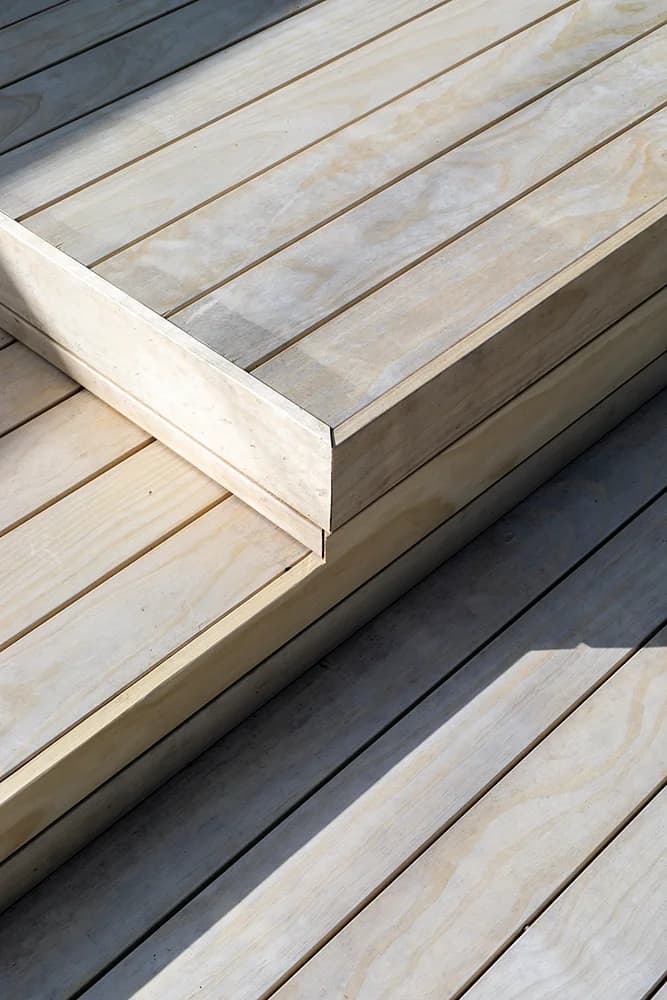
Fast-growing radiata pine from sustainably managed, FSC®-certified forests.
Heat, pressure and acetic anhydride (a vinegar derivative): the wood’s structure is modified through its full thickness — not just at the surface.
A Use Class 4 (UC4) wood, outstanding stability, no added biocide. Backed by the manufacturer for up to 50 years above ground, subject to conditions.
In the Caribbean, people ask for a “class 4 wood”: that is Use Class 4 (UC4, standard EN 335) — wood fit for ground and freshwater contact. Pressure-treated pine gets there by chemical impregnation; Accoya gets there by nature, through its intrinsic Class 1 durability (EN 350, the highest rating), achieved by acetylation, with no biocide. The same requirement, without treatment chemicals — and with a written manufacturer warranty.
The decking match
The honest comparison, criterion by criterion. Every material has its qualities — but only one ticks every box in our climate.
| Criterion | Accoya® | Ipe | Teak | Composite (WPC) |
|---|---|---|---|---|
| Lifespan & warranty | Use Class 4 (UC4) — manufacturer warranty of 25 to 50 years, subject to conditions | Reputedly very durable, no manufacturer warranty | Durable depending on origin, no manufacturer warranty | Varies by brand and range |
| Maintenance | Annual clean. Natural silver-grey patina, or saturating oil to keep the tone | Regular brightener and saturating oil | Regular oiling | Cleaning; scratches and stains hard to repair |
| Barefoot comfort | Smooth surface, splinter-free, non-toxic | Good, splinters possible with age | Good | Plastic surface |
| Heat in full sun | Among the coolest: light wood, low thermal conductivity | Dense, dark wood: it heats up more | Moderate | Can become burning hot |
| Stability (gaps, flatness) | Almost no shrinkage or swelling: fine, consistent gaps | Moves with humidity | Fair | Thermal expansion to allow for |
| Environment | FSC®, Cradle to Cradle Gold, fast-growing, 100% recyclable | Tropical hardwood: supply chain needs vigilance | Plantations: variable quality | Wood-plastic blend, hard to recycle |
Indicative comparison, based on data published by the manufacturer Accsys (stability, durability and thermography testing) and common maintenance practice. The performance of tropical hardwoods and composites varies by origin, brand and workmanship.
Here, not elsewhere
Constant humidity, intense sun, termites, sea spray: daily life for a deck in Guadeloupe or Martinique. Here is how Accoya answers.
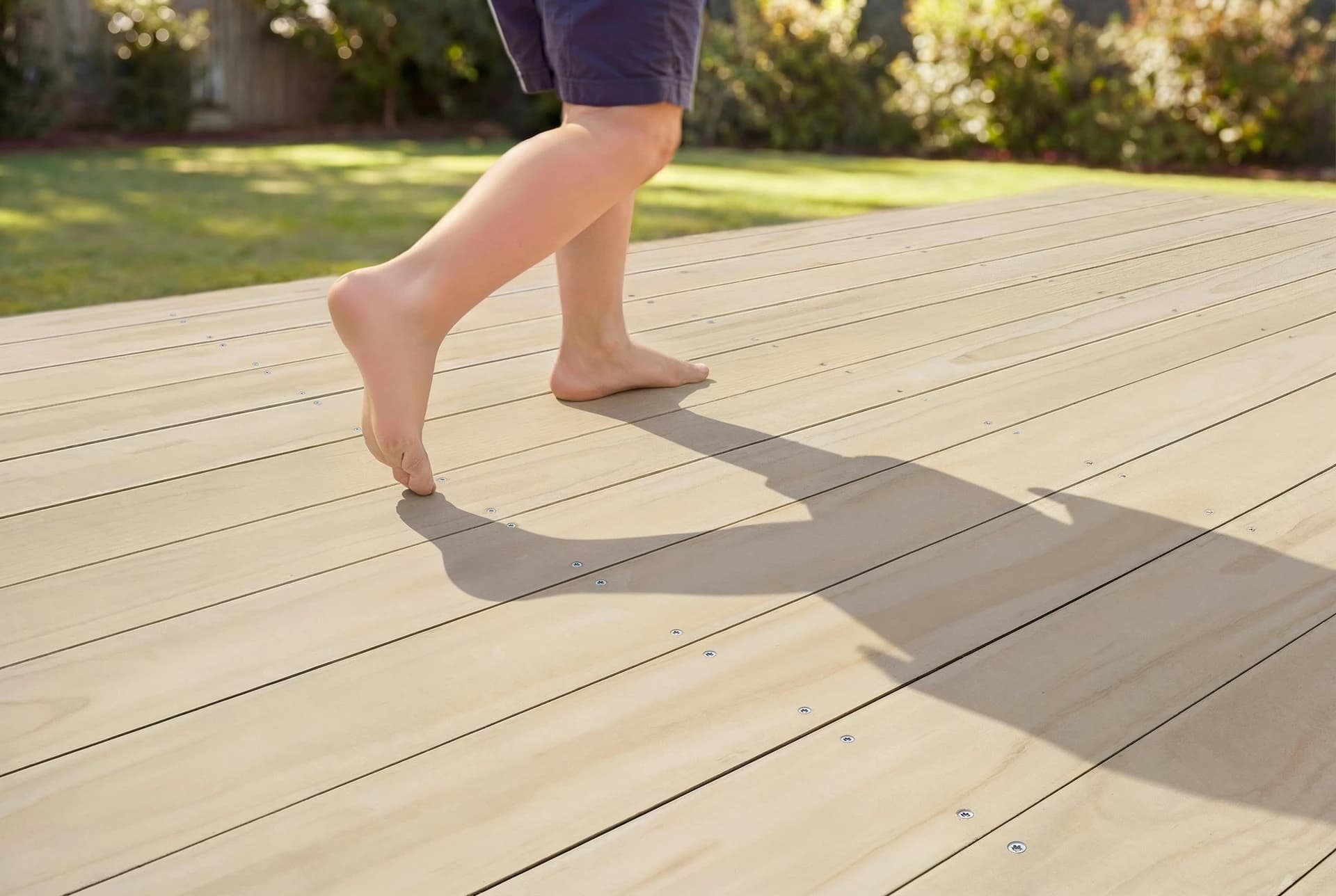
Rainy season, condensation, pool surrounds: Accoya is made for water — the manufacturer even warrants it immersed in freshwater. No more cupping or lifting boards.
Acetylated wood is no longer recognised as a food source: it resists termites and wood-boring insects, with no added chemical treatment. Decisive in the Caribbean.
Left natural, it takes on a beautiful silver-grey patina; a saturating oil revives it if you prefer the original tone. Want grey from day one? Accoya Color Grey is tinted through the full thickness. And the wood’s stability makes finishes last far longer (10-year trials).
Designed for every climate, it is used on pontoons and seafront decks. At installation, we pair it with marine-grade stainless-steel screws.
Certifications
Wood from sustainably managed forests, from seedling to board.
The global eco-design certification, achieved at Gold level.
The only construction material in the world certified Platinum for material health.
50 years above ground, 25 years in ground or freshwater contact — transferable, subject to installation conditions.
The warranty is issued by Accsys, the manufacturer of Accoya® wood: 25 years for wood installed in ground contact, 50 years above ground — provided the installation follows its specifications, notably a ground clearance of at least 200 mm and good ventilation. That is precisely how our teams install.
See installation done by the bookOrder your boards by the m², or request a quote for a deck installed by our teams.